
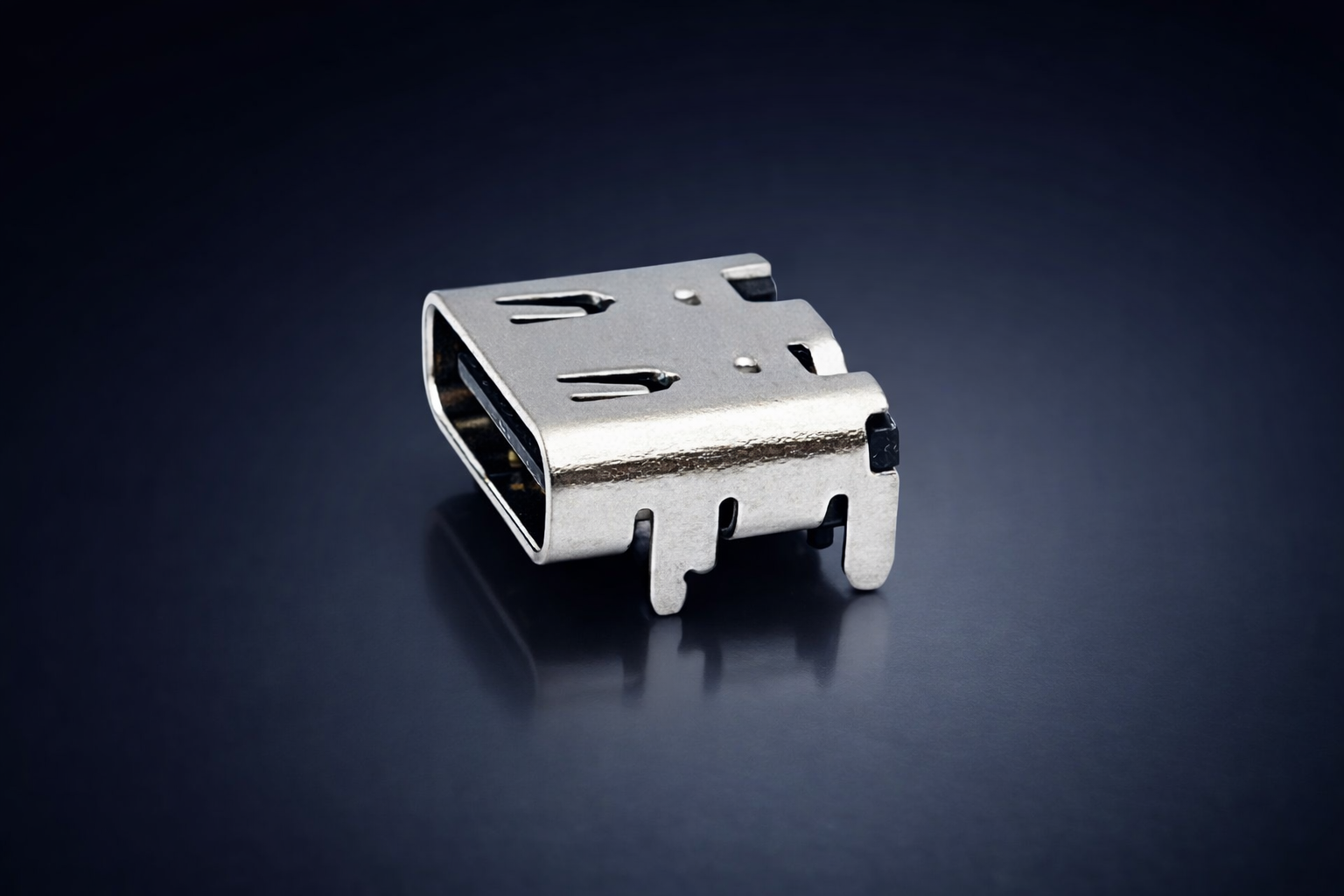
🔍 Do You Know? 10 Things You Probably Didn’t Know About USB Type-C Connectors
When people see a USB Type-C port, they think:
“Fast charging. High speed. Modern.”
But behind that small reversible interface lies a surprisingly complex engineering design.
Let’s take a deeper look — using our D13-0824-16007 USB Type-C Receptacle as an example.
1️⃣ Do You Know…
USB-C Is Not a Speed Standard?
Many assume USB-C automatically means high speed.
In reality, USB-C only defines the connector form factor.
The actual data rate depends on the internal protocol:
-
USB 2.0
-
USB 3.2
-
USB4
-
Thunderbolt
Two connectors may look identical externally — but perform completely differently.
That’s why connector selection must align with your system architecture.
2️⃣ Do You Know…
USB-C Has 24 Pins — But Not All Are Always Used?
A full USB-C interface includes 24 contacts.
However, actual usage depends on application requirements:
-
USB 2.0 only
-
SuperSpeed lanes enabled
-
Alternate Mode supported
-
Power Delivery integrated
Different use cases require different internal routing designs.
Choosing the correct receptacle configuration is critical.
3️⃣ Do You Know…
Reversible Plugging Requires Mirror Signal Design?
USB-C’s reversible feature is not mechanical convenience — it’s electrical engineering.
-
Differential signal pairs are mirrored
-
CC pins detect orientation
-
The system dynamically configures signal routing
This symmetry requires precision terminal layout and signal integrity control.
4️⃣ Do You Know…
Mating Cycle Durability Determines Product Lifespan?
Standard USB-C connectors are typically rated for 10,000+ insertion cycles.
In real-world environments:
-
Industrial systems require frequent maintenance
-
Medical devices undergo regular reconnections
-
Automotive applications face vibration stress
Terminal spring design and plating thickness directly affect long-term reliability.
5️⃣ Do You Know…
Gold Plating Thickness Dramatically Impacts Performance?
10 µ″ vs 15 µ″ vs 30 µ″ gold plating is not just a numeric difference.
It influences:
-
Contact resistance stability
-
Oxidation resistance
-
Long-term signal integrity
-
Cost sensitivity (especially during gold price fluctuations)
For professional applications, plating specification is a strategic decision — not a cosmetic one.
6️⃣ Do You Know…
USB-C Can Transmit Video Signals?
Through Alternate Mode, USB-C can support:
-
DisplayPort output
-
High-resolution video
-
Multi-function docking
A compact connector may be handling high-bandwidth video data while delivering power simultaneously.
7️⃣ Do You Know…
Mechanical Reinforcement Is Critical?
USB-C ports are often the primary power interface of a device.
Without structural reinforcement:
-
PCB stress may increase
-
Solder joints may fatigue
-
Shield tabs may loosen
Well-designed receptacles integrate mounting posts and shield anchoring to improve mechanical stability.
8️⃣ Do You Know…
Different Industries Demand Different USB-C Priorities?
| Industry | Key Focus |
|---|---|
| Consumer Electronics | Slim design, cost efficiency |
| Industrial Equipment | Stability, durability |
| Automotive | Vibration & temperature resistance |
| Medical Devices | Reliability & hygiene compliance |
Although the connector name is the same, design priorities vary significantly.
9️⃣ Do You Know…
USB-C Is Becoming a Global Standard?
USB-C is increasingly adopted as the unified charging interface across devices worldwide.
This is no longer just a design trend — it is becoming regulatory direction in multiple markets.
Devices without USB-C risk appearing outdated in today’s ecosystem.
🔟 Do You Know…
Connectors Are Often the Most Overlooked — Yet Most Failure-Prone Component?
System failures are frequently traced not to ICs, but to:
-
Contact instability
-
Terminal fatigue
-
Plating wear
-
Mechanical stress
Connectors may be small components —
but they determine the reliability of the entire product.
Conclusion
USB Type-C is more than a port.
It is:
-
A power entry system
-
A high-speed data channel
-
A video transmission path
-
A mechanical stress point
-
A daily user interaction interface
When upgrading a product, improvement often starts at the connector level.
🏢 About Walta Electronic
Walta Electronic specializes in high-quality connectivity solutions, providing a full range of USB Type-C, HDMI, DisplayPort connectors, Board-to-Board connectors, power connectors, as well as custom cables and wire harness assemblies. With precision manufacturing and advanced R&D, we serve premium applications across consumer electronics, medical technology, industrial control, Telecommunications, and automotive electronics — helping our partners stay competitive with performance they can trust.
👉 Follow us on LinkedIn for the latest product updates and connector insights.