
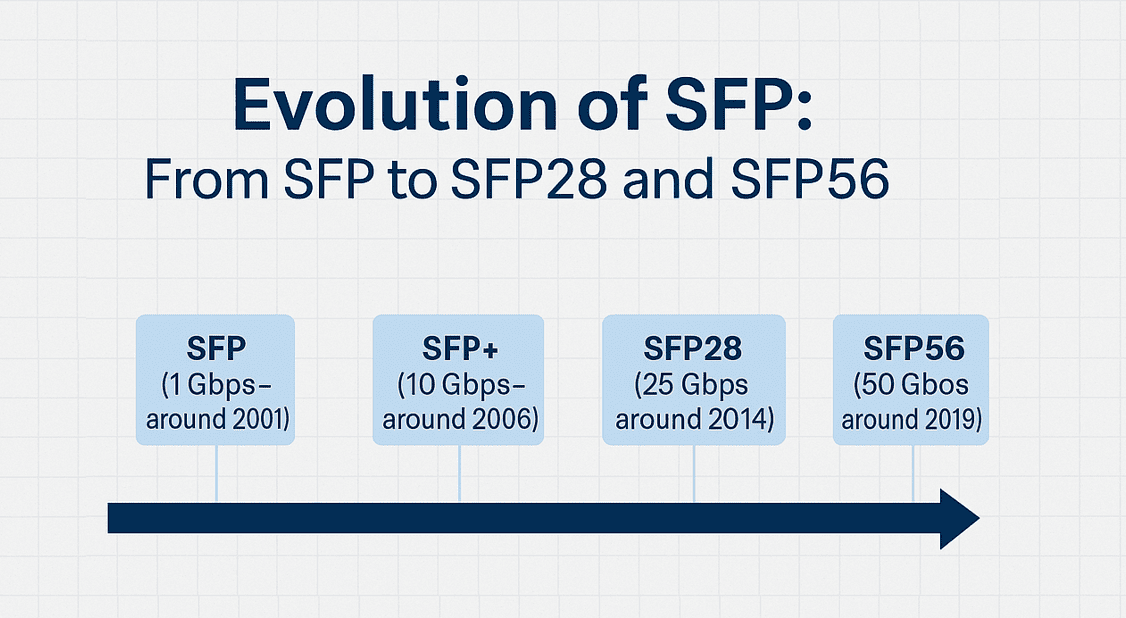
Evolution of SFP: From SFP to SFP28 and SFP56
Smaller, Faster, Smarter – How SFP Connectors Shaped the Modern Network
As global data demand accelerates through cloud computing, AI, and 5G, network hardware continues to evolve toward higher bandwidth and denser port designs. Among the countless interface formats, the Small Form-factor Pluggable (SFP) family has remained the backbone of modern networking, continually reinvented to deliver faster speeds while preserving compatibility and flexibility.
From 1 G to 50 G: A Brief Timeline
-
SFP (1 Gbps – around 2001)
The original SFP replaced bulky GBIC modules, offering a compact, hot-swappable transceiver interface for switches, routers, and storage systems. It standardized the small-form design we still see today. -
SFP+ (10 Gbps – around 2006)
As 10 Gigabit Ethernet became mainstream, SFP+ boosted data rates ten-fold without changing the physical size. Its backward compatibility made upgrades simple and cost-effective. -
SFP28 (25 Gbps – around 2014)
Developed under IEEE 802.3by, SFP28 answered the need for higher bandwidth in data centers and 5 G networks — 25 Gbps per lane using the same compact footprint. This generation became the “sweet spot” for cloud-scale deployments: faster than SFP+, lower cost than 40 G solutions. -
SFP56 (50 Gbps – around 2019)
The latest member doubles the lane speed again to 50 Gbps, aligning with PCIe Gen4 and 200 G/400 G Ethernet architectures, while maintaining full mechanical compatibility with earlier versions.
Why 25 Gbps Became the “Sweet Spot”
The SFP28 standard struck the perfect balance between performance, cost, and power efficiency. It allowed hyperscale data centers to migrate from 10 G to 25 G per lane — and by grouping four SFP28 channels, achieve 100 G Ethernet connections with existing infrastructure.
For many network operators, it remains the most practical choice for achieving high bandwidth without overhauling switch architecture or cooling design.
🔍 Zoom In: SFP28 1×1 Connector & Cage Solution
Walta Electronic provides SFP28 1×1 connector and cage assemblies that combine precision engineering, stable performance, and flexible customization to meet the needs of modern high-speed systems.
Connector Highlights
-
25 Gbps high-speed signal performance with controlled impedance
-
Durable contact design supporting >200 mating cycles
-
Gold-plated terminals ensuring low signal loss and corrosion resistance
-
Compact footprint compatible with SFP+ layouts for easy upgrades
Cage Highlights
-
Optimized EMI shielding using stamped stainless-steel structure
-
Enhanced heat dissipation through ventilation hole design
-
Optional light-pipe and press-fit options for mechanical flexibility
-
1×1 modular form ideal for rack or board-level integration
📄 Technical Specifications:
Download SFP28 1×1 Connector Specification Sheet (PDF)
Download SFP 28 1×1 Cage Specification Sheet (PDF)
Looking Ahead: SFP56 and Beyond
With the rise of AI servers and edge computing, the demand for higher-speed interconnects continues. While SFP28 remains dominant in 25 G and 100 G infrastructure, SFP56 and QSFP112 are setting new standards for 50 G and 400 G applications. Walta Electronic continues to refine connector and cage solutions that meet these future-ready specifications — ensuring performance, reliability, and design continuity.
🏢 About Walta Electronic
Walta Electronic specializes in high-quality connectivity solutions, providing a full range of USB Type-C, HDMI, SD Card connectors, DisplayPort connectors, Board-to-Board connectors, power connectors, as well as custom cables and wire harness assemblies. With precision manufacturing and advanced R&D, we serve premium applications across consumer electronics, medical technology, industrial control, Telecommunications, and automotive electronics — helping our partners stay competitive with performance they can trust.