
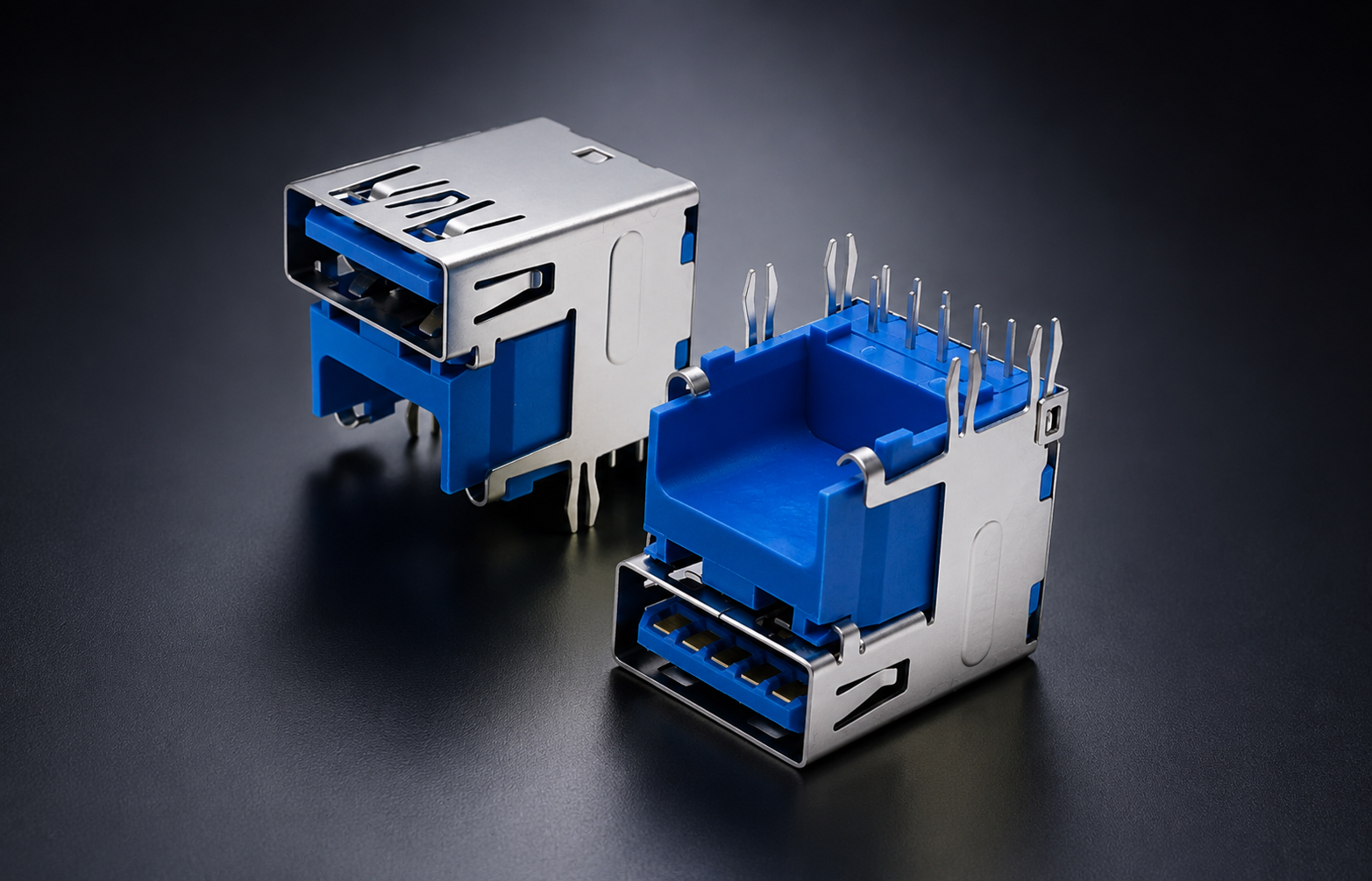
Why Elevated USB 3.0 Receptacles Matter in Modern Hardware Design
As industrial devices, AI edge systems, embedded computers, medical equipment, and high-speed consumer electronics continue evolving, connector selection has become far more than a simple mechanical decision. Today, engineers must balance signal integrity, mechanical durability, EMI stability, manufacturability, thermal constraints, and long-term reliability — especially in USB 3.0 applications.
One increasingly important solution in modern PCB and enclosure design is the USB 3.0 Elevated Receptacle, such as the D01-C124-00901 USB 3.0 Elevated Receptacle by Walta Electronic.
Unlike standard USB Type-A connectors, elevated receptacles are specifically engineered to solve structural and integration challenges commonly found in compact or multilayer device architectures.
What Is a USB 3.0 Elevated Receptacle?
A USB 3.0 elevated receptacle is a raised-height USB Type-A connector designed to create additional clearance between the PCB and the mating interface. This elevated structure allows engineers to better align ports with external enclosures while improving routing flexibility inside compact electronic devices.
The Walta Electronic D01-C124-00901 model is part of the company’s USB 3.0 connector portfolio and supports standard USB 3.0 SuperSpeed applications.
Key specifications include:
- Insulation Resistance: 100MΩ Min.
- Current Rating:
- 1.8A for VBUS and GND
- 0.25A for signal contacts
- Voltage Rating: DC 30V
- Dielectric Withstanding Voltage: 100V AC/min
- Contact Resistance:
- 30mΩ Max (VBUS/GND)
- 50mΩ Max (signal contacts)
- Durability: 1,500 mating cycles minimum
- Insertion Force: 35N Max
- Extraction Force: 10N Min
Why Elevated USB Connectors Are Becoming More Important
1. Better Mechanical Alignment for Modern Enclosures
Many modern embedded systems use:
- thick metal housings
- stacked PCB structures
- internal shielding
- thermal modules
- industrial-grade chassis
Traditional USB connectors often create alignment problems when the PCB sits deeper inside the enclosure. Engineers then need:
- custom brackets
- additional spacers
- floating structures
- complicated tolerance compensation
An elevated USB receptacle simplifies this problem directly at the connector level.
This reduces:
- mechanical stress
- assembly complexity
- alignment tolerance issues
- production variability
Especially in:
- industrial PCs
- edge AI computers
- mini PCs
- networking devices
- medical equipment
- automotive control systems
2. Improved PCB Routing Flexibility
USB 3.0 operates at high-speed differential signaling, where PCB routing quality directly affects signal integrity.
The elevated structure creates additional PCB clearance underneath the connector, helping engineers:
- optimize differential pair routing
- reduce via congestion
- improve layer transition management
- separate high-speed traces from noisy power regions
This becomes particularly useful in dense PCB designs involving:
- DDR memory
- PCIe lanes
- M.2 modules
- DisplayPort
- HDMI
- Ethernet PHY routing
In high-speed hardware design, connector placement is often one of the most overlooked causes of:
- EMI failures
- eye diagram degradation
- insertion loss
- unstable data transfer
Elevated USB connectors help reduce these risks.
3. Better EMI and Shielding Performance
EMI control is increasingly critical in modern electronics, especially for:
- industrial automation
- medical devices
- AI servers
- automotive electronics
- telecom systems
USB 3.0’s SuperSpeed architecture generates higher-frequency noise compared to USB 2.0, making shielding quality and grounding structure much more important.
The D01-C124-00901 USB 3.0 elevated receptacle incorporates shielding structures designed for stable grounding performance within high-speed I/O environments.
When properly integrated into system grounding architecture, elevated USB connectors can help:
- reduce EMI leakage
- improve enclosure grounding continuity
- stabilize high-speed transmission
- support EMC compliance efforts
4. Durability for Industrial and Commercial Applications
Consumer-grade USB connectors may not survive demanding environments involving:
- vibration
- repeated insertion cycles
- cable pulling stress
- thermal cycling
- industrial maintenance access
The D01-C124-00901 is rated for:
- 1,500 mating cycles minimum
- controlled insertion/extraction force
- stable contact resistance performance
These characteristics are important in:
- factory automation systems
- kiosks
- transportation equipment
- medical diagnostic devices
- industrial control systems
Typical Applications of USB 3.0 Elevated Receptacles
Industrial Computing
Industrial PCs often require rugged USB connectivity while maintaining enclosure clearance and EMI shielding.
AI Edge Devices
AI edge systems frequently combine:
- USB peripherals
- high-speed memory
- PCIe accelerators
- thermal modules
Elevated connectors improve layout flexibility in constrained spaces.
Medical Electronics
Medical systems require:
- stable signal integrity
- long-term durability
- EMI reliability
- secure mating performance
Networking & Telecom Equipment
Modern telecom devices frequently use USB interfaces for:
- diagnostics
- firmware updates
- peripheral expansion
Connector grounding stability becomes critical for EMC performance.
Consumer Electronics
Compact consumer devices benefit from elevated connectors when:
- enclosure thickness increases
- stacked boards are used
- thermal shielding is added
Why Connector Selection Impacts Product Reliability
Many hardware failures are not caused by ICs or firmware — they originate from connector-level issues such as:
- poor grounding
- weak shielding
- unstable contact resistance
- mechanical stress
- insufficient mating durability
- PCB strain during assembly
For high-speed USB 3.0 systems, the connector is part of the signal path itself.
A properly designed USB receptacle can significantly improve:
- long-term reliability
- manufacturing consistency
- EMI stability
- user experience
- field maintenance durability
USB 3.0 Connector Trends in 2026 and Beyond
Although USB Type-C continues growing rapidly, USB Type-A and USB 3.0 receptacles remain widely used in:
- industrial equipment
- embedded systems
- legacy-compatible platforms
- networking hardware
- medical systems
- enterprise infrastructure
Engineers increasingly prioritize:
- ruggedized connector structures
- elevated connector designs
- better shielding
- customized mechanical solutions
- high-cycle durability
This is especially true for OEM/ODM manufacturers developing long-lifecycle hardware platforms.
🏢 About Walta Electronic
Walta Electronic specializes in high-quality connectivity solutions, providing a full range of USB Type-C, HDMI, DisplayPort connectors, Board-to-Board connectors, power connectors, as well as custom cables and wire harness assemblies. With precision manufacturing and advanced R&D, we serve premium applications across consumer electronics, medical technology, industrial control, Telecommunications, and automotive electronics — helping our partners stay competitive with performance they can trust.
👉 Follow us on LinkedIn for the latest product updates and connector insights.。