
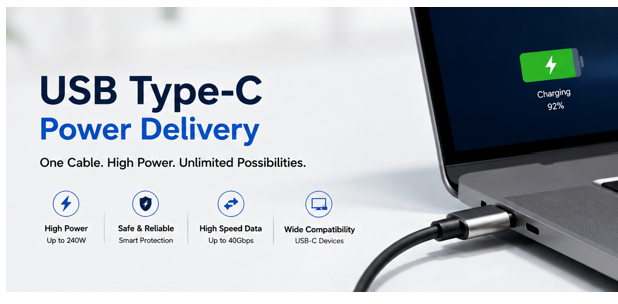
What Is USB Type-C Power Delivery?
USB Type-C Power Delivery (USB PD) is a fast-charging and power negotiation standard developed by the USB Implementers Forum (USB-IF). Unlike traditional USB interfaces that provide a fixed amount of power, USB PD enables devices to intelligently negotiate voltage and current levels, allowing significantly higher power delivery while maintaining safety and efficiency.
As modern electronics continue to demand more power, USB Type-C Power Delivery has become the industry standard for charging and powering smartphones, tablets, laptops, industrial equipment, medical devices, and automotive electronics.
Today, USB PD 3.1 supports up to 240W of power, making USB Type-C one of the most versatile connectivity standards available.
Why USB Power Delivery Matters
Traditional USB interfaces were originally designed for data transfer rather than high-power applications.
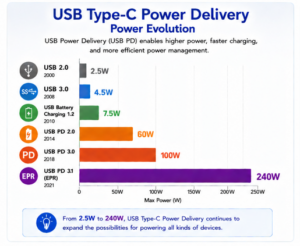
With the increasing adoption of USB Type-C, manufacturers can use a single connector for both high-speed data transmission and high-power charging, simplifying product design and improving user convenience.
Understanding USB Power Delivery Power Levels
USB PD allows devices to negotiate different voltage and current profiles based on their requirements.
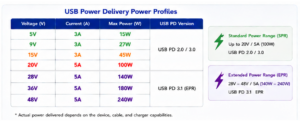
This flexibility allows USB Type-C connectors to support a wide range of applications, from charging mobile phones to powering high-performance laptops and industrial equipment.
How USB Type-C Power Delivery Works
One of the key advantages of USB PD is its intelligent power negotiation mechanism.
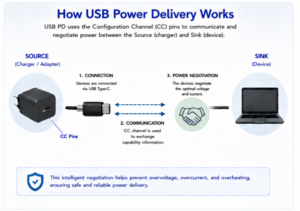
Before power is delivered, the Source device (such as a charger or power adapter) and the Sink device (such as a laptop or tablet) communicate through the Configuration Channel (CC) pins inside the USB Type-C connector.
The devices exchange information including:
- Supported voltage levels
- Current capabilities
- Maximum power requirements
- Power delivery profiles
Once both devices agree on a suitable power profile, power transmission begins.
This negotiation process helps prevent overvoltage, overheating, and excessive current flow, ensuring safe and efficient operation.
Connector Requirements for USB Power Delivery Applications
As power levels increase, connector quality becomes increasingly important.
Current Carrying Capacity
High-power USB PD applications require connectors capable of handling elevated current levels with minimal resistance.
Key considerations include:
- Low contact resistance
- Optimized terminal design
- Stable electrical performance
- High-quality contact materials
Poor connector design can lead to excessive heat generation and reduced system reliability.
Plating and Contact Reliability
Contact plating plays a critical role in maintaining long-term performance.
Proper plating helps:
- Reduce contact resistance
- Improve conductivity
- Enhance durability
- Prevent oxidation and corrosion
For applications involving frequent mating cycles, high-quality plating is particularly important.
Thermal Performance
As USB PD moves toward 100W, 140W, and even 240W power levels, thermal management becomes a major design consideration.
Engineers should evaluate:
- Temperature rise during operation
- Connector material selection
- Ventilation and cooling conditions
- Long-term reliability under continuous load
Durability
USB Type-C connectors are designed for repeated insertion and removal.
Typical requirements include:
- More than 10,000 mating cycles
- Stable mechanical retention
- Consistent electrical performance over time
For industrial and medical applications, durability often becomes a key selection factor.
Common Applications of USB Type-C Power Delivery
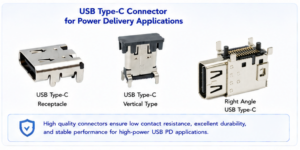
Consumer Electronics
USB PD is widely used in:
- Smartphones
- Tablets
- Laptops
- Gaming devices
- Portable accessories
Industrial Equipment
Industrial systems increasingly adopt USB Type-C for both power and communication.
Examples include:
- Industrial PCs
- Embedded systems
- Human-machine interfaces (HMIs)
- Portable test instruments
Medical Devices
Portable medical equipment benefits from standardized power delivery and compact connector designs.
Applications include:
- Patient monitoring devices
- Portable diagnostic systems
- Medical tablets and terminals
Automotive Electronics
USB Type-C Power Delivery is becoming increasingly common in modern vehicles.
Applications include:
- In-vehicle charging systems
- Infotainment systems
- Rear-seat entertainment systems
- Connected vehicle electronics
How to Select the Right USB Type-C Connector
Choosing the appropriate USB Type-C connector requires careful evaluation of application requirements.
Consider the following factors:
Power Requirements
Determine the maximum power level required:
- Standard charging
- Fast charging
- 100W USB PD
- 240W USB PD 3.1
Mounting Style
Select the appropriate connector configuration:
- Receptacle
- Plug
- Mid-mount
- Top-mount
- Vertical
- Right-angle
Environmental Conditions
Consider:
- Operating temperature
- Humidity exposure
- Vibration
- Dust protection requirements
Durability Requirements
Evaluate expected insertion cycles and mechanical stress throughout the product lifecycle.
Conclusion
USB Type-C Power Delivery has transformed USB from a simple data interface into a universal high-power connectivity solution. With support for up to 240W, USB PD enables a single connector to deliver power, data, and convenience across a wide range of applications.
For engineers and product designers, selecting the right USB Type-C connector is critical to ensuring reliable power delivery, thermal performance, durability, and long-term product success.
As USB Type-C adoption continues to expand across consumer, industrial, medical, and automotive markets, connector quality and design considerations will play an increasingly important role in achieving optimal system performance.
Frequently Asked Questions (FAQ)
What is USB Type-C Power Delivery?
USB Type-C Power Delivery (USB PD) is a charging and power negotiation standard that enables devices to safely deliver higher levels of power through a USB Type-C connector. The latest USB PD 3.1 specification supports up to 240W of power.
How does USB Power Delivery work?
USB Power Delivery uses the Configuration Channel (CC) pins within a USB Type-C connector to allow devices to communicate and negotiate voltage and current requirements before power is delivered.
What is the difference between USB Type-C and USB Power Delivery?
USB Type-C refers to the physical connector interface, while USB Power Delivery (USB PD) is the protocol that manages power transmission. A USB Type-C connector does not automatically support USB PD unless the device and circuitry are designed for it.
How much power can USB Type-C deliver?
Standard USB Type-C can provide up to 15W (5V/3A). With USB Power Delivery, power levels can reach 100W, while USB PD 3.1 Extended Power Range (EPR) supports up to 240W.
Can all USB Type-C connectors support 240W charging?
No. To support 240W charging, the connector, cable assembly, and device design must comply with USB PD 3.1 EPR specifications and be capable of handling higher voltage and current requirements.
Why is connector quality important for USB Power Delivery applications?
High-power USB PD applications require connectors with low contact resistance, reliable plating, strong mechanical durability, and good thermal performance to ensure safe and stable operation.
How do I choose the right USB Type-C connector for my application?
Key considerations include power requirements, mounting style, durability, environmental conditions, shielding requirements, and compliance with relevant USB standards.
Are USB Type-C connectors suitable for industrial and medical applications?
Yes. USB Type-C connectors are increasingly used in industrial automation, embedded systems, portable medical devices, and automotive electronics due to their compact design, high power capability, and versatility.
About Walta Electronic
Walta Electronic specializes in high-quality connectivity solutions, providing a full range of DisplayPort, HDMI, USB, and Type-C connectors, along with corresponding cables and customized wire harness solutions. With precision manufacturing and advanced R&D expertise, we deliver high-performance, reliable connectivity products for applications across consumer electronics, industrial equipment, medical technology, and automotive electronics.
Our mission is to enhance connectivity solutions, ensuring superior compatibility and long-term competitiveness for our customers.